The next social engineering attack may start far from the office
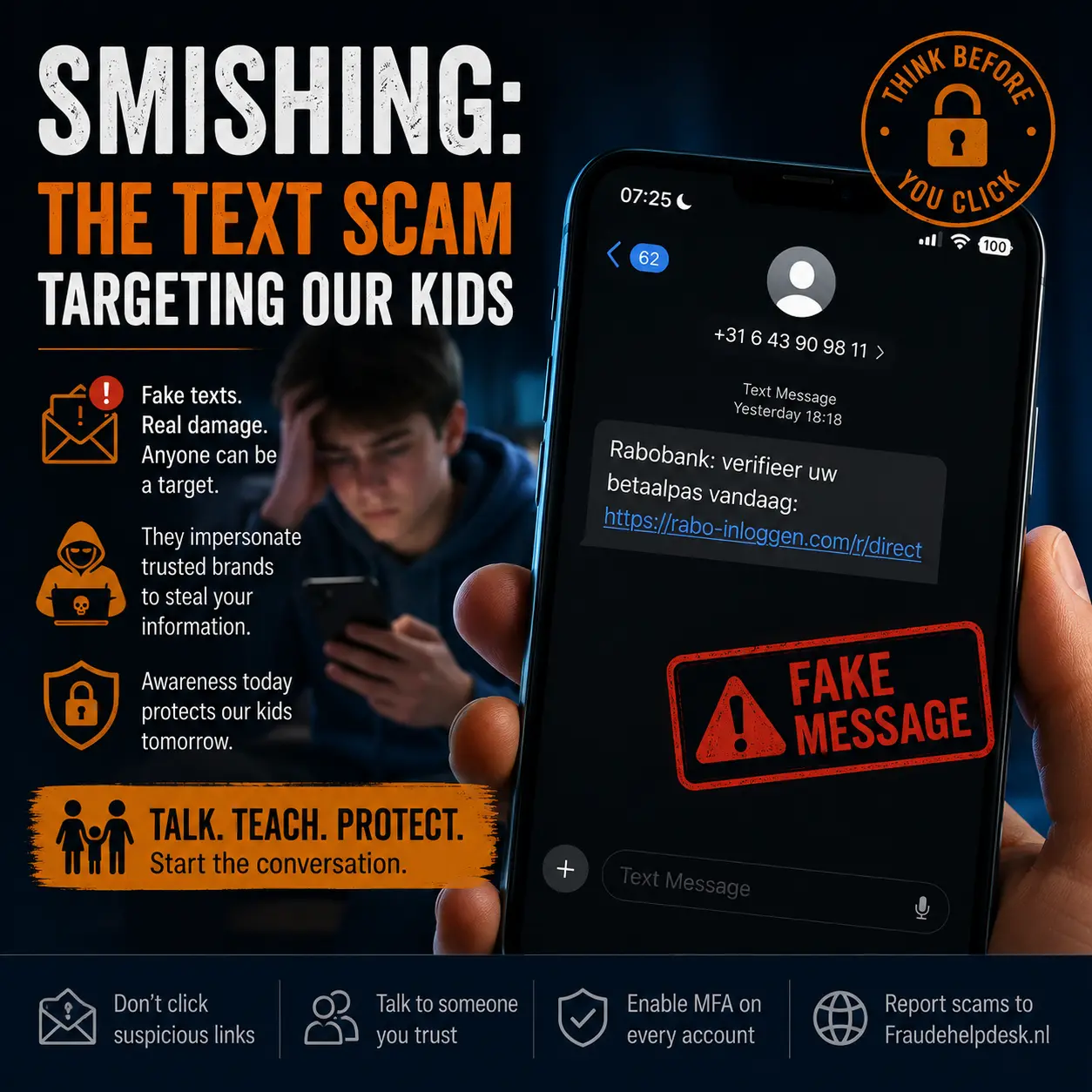
Last week, I wrote about a fake Rabobank text message that my son received despite not being a Rabobank customer.
Like many parents, I know that young people can be trusting. They spend much of their day online: social media, gaming platforms, messaging apps, and increasingly AI-powered services. They connect, share, click, and communicate in ways that feel completely natural to them.
Most of us worry about the risks to our children.
But perhaps we should also consider a different question:
Could the information our children share online create risks for us, our businesses, or the organizations we work for?
The reality is that cybercriminals are no longer just targeting systems. They are targeting people. Modern social engineering relies on gathering small pieces of information and turning them into believable stories, trusted identities, and convincing attacks.
Our children are not the threat
But they may unknowingly become part of the information ecosystem that attackers use to profile, target, and influence their next victim.
Hacking people is often easier than hacking cyber protected systems
Organizations spend millions on firewalls, endpoint protection, email security, multi-factor authentication, and security monitoring. Yet despite these investments, cybercriminals continue to find ways in.
Why?
However, hacking people is often easier than hacking well-protected systems.
Rather than attacking technology directly, modern cybercriminals increasingly rely on social engineering, the art of manipulating people into revealing information, clicking malicious links, approving fraudulent requests, or trusting someone they shouldn't.
This is not a hypothetical risk.
While these studies focus on executives, the lesson applies much more broadly. Modern social engineering is built on context. Attackers collect information about spouses, children, hobbies, schools, travel plans, employers, and social connections to build trust and make their attacks more convincing.
In addition, the people researching your company are not only looking at your website, LinkedIn profile, or technology stack.
They may also be looking at your household.
Cybersecurity awareness should not stop at the office door
Some organizations have already recognized this reality.
Executive protection is no longer limited to the office. Increasingly, large organizations are extending cybersecurity awareness and digital protection programs to executives' households. The objective is simple: help family members recognize social engineering attempts and understand the value of personal information.
As a result, the risk of becoming an unintended entry point for attackers goes down.
There's no need to create fear here. What matters is awareness.
Therefore, just as employees receive cybersecurity training at work, families can benefit from understanding a few basic principles:
✓ Do's
- Be cautious when receiving unexpected text messages, emails, or phone calls.
- Verify requests involving money, passwords, or personal information.
- Think before sharing photos that reveal locations, schools, travel plans, or work-related information.
- Discuss online scams and social engineering as a family.
- Report suspicious messages rather than ignoring them.
✗ Don'ts
- Don't share travel plans publicly before or during a trip.
- Avoid publishing information that reveals where parents work, especially in combination with personal details.
- Never click links from unknown senders.
- Don't trust a caller, message, or video simply because it appears familiar.
- Information shared online is rarely visible to friends only, so don't assume otherwise.
Cybersecurity awareness should not stop at the office door.
In a world where attackers target people as much as technology, a short conversation at the dinner table may be just as valuable as the latest security tool.
At Magicstone we help SME businesses strengthen cyber resilience through awareness training, email security and AI-powered protection.
Talk to us →