AI-Powered Email Security for Microsoft 365 & Google Workspace
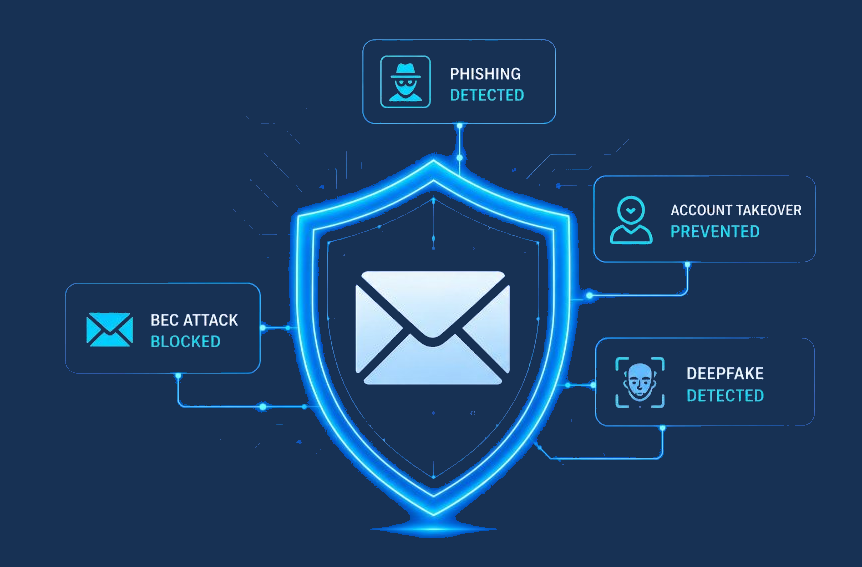
Stop phishing, business email compromise, account takeover, QR phishing and deepfake attacks before they reach your users. Magic Stone delivers advanced AI-powered email security that protects your organisation against modern inbox threats while supporting NIS2, DORA and GDPR readiness.
What Is AI-Powered Email Security?
AI-powered email security uses artificial intelligence, behavioural analysis, machine learning and threat intelligence to detect phishing, business email compromise, account takeover, QR phishing and deepfake attacks that traditional email filters often miss.
Unlike traditional email security solutions that rely mainly on signatures, blacklists and known indicators, AI-powered email security analyses behaviour, communication patterns and contextual anomalies to identify threats before users interact with them.
Modern organisations use AI-powered email security to protect Microsoft 365 and Google Workspace environments while strengthening cybersecurity controls and supporting NIS2, DORA and GDPR requirements.
Why Email Security Matters
Email is not just a communication tool. It is the primary attack surface of most organisations. Attackers use email to steal credentials, impersonate executives, compromise suppliers, redirect payments and deliver ransomware.
Built-in email filters from Microsoft and Google provide a useful baseline, but today’s attacks are designed to look legitimate. They often contain no malware, no suspicious attachments and no obvious indicators of compromise.
Common Email Security Threats
Phishing
Credential theft, fake login pages, malicious links and social engineering emails designed to trick users into giving attackers access.
Business Email Compromise
Fraudulent payment requests, executive impersonation and vendor fraud that often contain no malware or suspicious links.
Account Takeover
Compromised email accounts used to send trusted internal phishing emails, intercept conversations or redirect payments.
QR Phishing
Malicious links hidden inside QR codes, designed to bypass traditional email link scanners and move users to mobile devices.
Deepfake Attacks
AI-generated impersonation attempts, including executive-style messages and fraud supported by voice or video manipulation.
Zero-Day Email Threats
New attack techniques that have not yet been classified, blacklisted or added to traditional detection databases.
How Magic Stone Helps
- Detect advanced phishing attacks before users engage with them.
- Prevent Business Email Compromise and executive impersonation.
- Identify Account Takeover activity from trusted internal accounts.
- Block QR phishing campaigns hidden inside images.
- Detect deepfake-driven and AI-generated impersonation attempts.
- Protect Microsoft 365 and Google Workspace environments.
- Support NIS2, GDPR and DORA cybersecurity readiness.
- Reduce manual security workload through automated detection and remediation.
Advanced email security is relevant for organisations that:
- Use Microsoft 365 or Google Workspace.
- Handle payments, invoices, contracts or supplier communications by email.
- Are exposed to phishing, ransomware, account takeover or BEC attempts.
- Need stronger protection for executives, finance teams and procurement teams.
- Must comply with NIS2, DORA, GDPR or internal cybersecurity requirements.
- Want enterprise-grade protection without unnecessary complexity.
Powered by IRONSCALES
Magic Stone delivers advanced email security through IRONSCALES, an AI-powered email security platform that combines artificial intelligence, behavioural analysis and human intelligence to detect and remediate email threats.
IRONSCALES protects Microsoft 365 and Google Workspace environments against phishing, BEC, account takeover, deepfake threats and QR phishing without requiring complex mail-flow changes.
Learn more about our IRONSCALES AI Email Security solution, our NIS2 guidance, and our DORA compliance approach.
Why Microsoft Defender Alone Is Not Always Enough
Microsoft Defender for Office 365 is a useful security baseline. It helps block known spam, malware and phishing campaigns at scale. However, many of today’s most damaging attacks are targeted, context-aware and designed to avoid traditional detection.
Business Email Compromise, vendor impersonation, account takeover and deepfake-style attacks often use trusted identities, normal business language and clean infrastructure. These attacks may not contain a malicious attachment or obvious suspicious link.
A dedicated AI email security layer adds behavioural detection, contextual analysis and automated remediation to help identify the threats that default tools can miss.
Email Security and Compliance
Email security is an important part of cybersecurity governance, privacy protection and operational resilience. NIS2 requires organisations to apply appropriate cybersecurity risk management measures. DORA requires financial entities to maintain robust ICT controls. GDPR requires protection of personal data against unauthorised access or disclosure.
AI-powered email security helps organisations reduce email-borne risk, strengthen incident prevention and demonstrate layered protection as part of a broader compliance and resilience strategy.
Frequently Asked Questions
Why isn’t Microsoft Defender enough for email security?
Microsoft Defender is a good baseline, but advanced attacks such as BEC, executive impersonation, account takeover, QR phishing and deepfake-style threats are designed to look legitimate and may bypass traditional filtering.
What is Business Email Compromise?
Business Email Compromise, or BEC, is when attackers impersonate executives, vendors or trusted partners to trick employees into transferring money, changing payment details or sharing sensitive information.
What is Account Takeover?
Account Takeover happens when an attacker gains access to a legitimate email account and uses it to send phishing emails, intercept payment conversations or attack colleagues and customers from a trusted identity.
What is QR phishing?
QR phishing, also called quishing, uses QR codes in emails to hide malicious links. Users scan the code with a mobile device and are taken to a phishing page outside normal email link scanning.
What are deepfake email threats?
Deepfake email threats use AI-generated content to impersonate executives, suppliers or trusted contacts. They may be combined with voice-clone calls or realistic writing styles to increase credibility.
Does AI email security help with NIS2 and DORA?
Yes. AI email security supports cybersecurity risk management by reducing email-borne threats, improving detection and remediation, and providing stronger protection against phishing, account compromise and fraud.
How is AI email security different from spam filtering?
Spam filtering focuses on bulk unwanted email and known patterns. AI email security focuses on advanced and targeted attacks by analysing behaviour, context, language, sender patterns and anomalies.
How quickly can email security be deployed?
Deployment depends on the environment, but API-based email security can often be connected quickly to Microsoft 365 or Google Workspace without complex mail-flow changes or MX record changes.
Ready to Strengthen Your Email Security?
Discover how AI-powered email security can reduce phishing risk, prevent account compromise, block modern email threats and support your compliance objectives.
Schedule an Email Security ConsultationMagic Stone
Your Security Partner, Not Just a Provider

IRONSCALES

Darktrace